
Silent Auction

'helping nature thrive'

facilitated by Banks Peninsula Conservation Trust
“Pest Free Banks Peninsula is an excellent example of the classic dilemma – no one entity, agency or group can achieve pest elimination on their own, but by working as a partnership, we are showing that it can be achieved.”
Brett Butland, PF Program Lead
Introduced pests are a major threat not only to native biodiversity on the peninsula, but also to farming and tourism businesses, cultural values, and recreational assets. Pest Free Banks Peninsula is a community-led, agency-supported programme to restore biodiversity by eliminating or controlling pest animals across the peninsula’s entire 110,000 ha area.
The PFBP partnership includes representatives from 27 local and regional organisations, agencies, Runanga, community and volunteer groups and landowners. At a strategic level, Pest Free Banks Peninsula delivers Goal 8 of the 2050 Banks Peninsula Ecological Vision, which is to eliminate or control pest animals across the peninsula's entire 110,000 ha area to protect native biodiversity. As with the other aspects of this Ecological Vision, the pest free programme delivers wider benefits - it supports Ngāi Tahu values, community wellbeing and development, and sustainable agriculture and tourism.
Pest Free Banks Peninsula Partners
%20conv%201.jpeg)
-
Rod Carr (Chair) - Banks Peninsula Conservation Trust
-
Rik Tainui - Ōnuku Rūnanga, Te Hapū o Ngāti Wheke Rūnanga, Te Rūnanga o Koukourārata, Te Taumutu Rūnanga and Wairewa Rūnanga
-
Jo Macpherson - Department of Conservation
-
Aaron McGlinchy - Selwyn District Council
-
Nick Moody- Environment Canterbury
-
Simon Brittan - Christchurch City Council
-
Niki Mealings - Waimakariri District Council
-
David Miller (Chair) - Banks Peninsula Conservation Trust, landowner
-
Alison Evans - Christchurch City Council
-
Paul Devlin - Christchurch City Council
-
Anna Cameron - Rod Donald Banks Peninsula Trust
-
Hugh Eaton - Banks Peninsula Conservation Trust, landowner
-
Laura Molles - Banks Peninsula Conservation Trust, ecologist
-
Denise Ford - Selwyn District Council
-
Shaun Burkett - Environment Canterbury
-
Bethany Baker - Department of Conservation
-
Matthew Hellicar - Cacophony Project
-
Sarah Wilson - Whaka Ora Healthy Harbour Project
-
Paul Delatour - Landowner
-
Lawrence Smith - Re:Wild Wainui, landowner
-
Dr Patrick Garvey - Senior Scientist, Landcare Research
-
Nathan McNally - Strategic Projects Advisor, Department of Conservation
-
Dr Elaine Murphy - Principal Scientist, Department of Conservation
-
Thomas Emmitt - Technical Advisor, Department of Conservation
-
Steve Hicks - Independent Predator Control Specialist
-
Jonah Kitto-Verhoef - Project Manager, Predator Free Dunedin
-
Dave Hunter - Independent Predator Control Specialist
-
Prof James Ross - Lincoln University
-
Rory McNamara - Project Manager (Animal Pests), Christchurch City Council

When the PFBP project was launched, we thought our biggest challenge would be the fact that we’re operating in a living landscape. Many of the other predator free landscape projects at the time were being carried out in remote national parks, or across swathes of public land, whereas we’re working on people’s farms, in their backyards, in local parks and reserves.
That challenge has proved to be one of our biggest success factors. Relationships are at the heart of our work, and our communities have embraced, engaged with and supported our mahi. They are the cornerstone of our success.
The PFBP project is funded in part by the region’s ratepayers, through a targeted ECan biodiversity rate, and from funding received from Christchurch City Council and Selwyn District Council. We also receive funding for taxpayers, through the Department of Conservation and Ministry for Primary Industries.
We are grateful for the continued financial investment in our work by our councils, communities, government, businesses and philanthropic organisations.
%20conv%201.jpeg)
2026 heralded a new approach for PFBP – with the team releasing its ‘feasibly ambitious’ updated strategy, which includes a new goal of eliminating possums, mustelids, feral cats and lagomorphs (rabbits and hares) by 2030 (rather than by 2050). PFBP is now five years in, so now’s the time to use what we’ve learned along the way to ensure we’re delivering transformational impact.
New funding will be sought to extend possum elimination on the peninsula, based on the programme’s successful progress to date, and more resources applied to multi-species elimination on Kaitorete. The expected end results of this new approach and investment include enhanced primary production values, increased recreational and tourism assets, and better ecological outcomes, including opportunities for translocation and reintroduction of suitable species to suitable sites.
The original strategy treated Banks Peninsula as a mainland 110,000 ha ‘island’ where we were seeking to systematically eliminate predators in staged phases, which would enable native species to recolonise large, connected areas rather than surviving in fragments. What we’re attempting now is to create a massive ‘buffer zone’ around the peninsula, including a community-led ‘virtual barrier’ over the Port Hills and Whakaraupō catchment.
We will establish a ‘proof of concept’ for multi-species elimination in the southern bays of Banks Peninsula and prepare to expand westward to eliminate pest animals from 1 million ha between the coast, Southern Alps, and Rakaia and Ashley rivers under the Pest Free Waitaha umbrella.
One thing that remained unchanged in the strategy revision was the pest free program’s continued reliance upon, and commitment to, peninsula communities. The project was established by the community who have supported us at every step, and in areas where we have achieved elimination, they are key to retaining that status. For the past five years, hundreds of peninsula farmers have trusted us to be on their property, residents have allowed us to set up traps and cameras in their backyards, communities have set up their own trap lines. They see the value in our work, and we are absolutely committed to delivering to our communities’ needs and expectations.
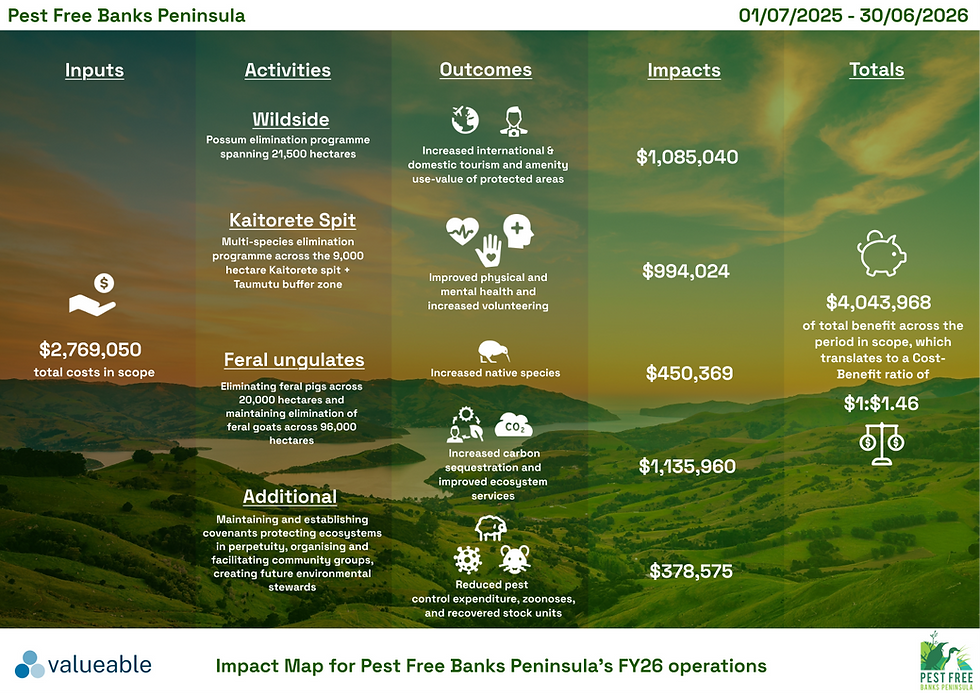
When we talk about ‘return on investment’ in the pest free context, we tend to focus on the rejuvenation of biodiversity. But there are wider economic and social impacts of creating pest-free environments and in 2025, we commissioned a report into the PFBP program’s economic and associated impacts. It showed that from the $2.7M invested in the program to date, it had returned a total benefit of $4.04M, which translates to a cost/benefit ratio of a $1.46 for every $1 invested.
This impact is further backed up by other published and anecdotal research, including by Federated Farmers and Forest and Bird. Federated Farmers know the cost to the agricultural sector of feral goats, pigs, deer and other pest animals coming out of the forests and mowing down crops and wrecking pastures,” said Project Lead, Brett Butland. “But there’s also the ‘lost opportunity’ costs - particularly around our carbon emissions reduction targets. We know that if we can reduce invasive pests down to very low levels, it will allow forest recovery to such an extent that it could reduce our carbon output by 15%.
The team receives a lot of positive feedback from farmers and people in the community, who are now making the connection between pest control and positive environmental impacts. We don't base our success on the numbers of pests removed, but on the impact of their removal. Success for farmers can mean better pastures and crops and not having to spend time and money on TB-related livestock management and disease control. For businesses, they might see an increase in visitor numbers, and for residents it could be birdsong, bumper fruit crops or a garden full of healthy roses. That’s the real value in our work - people recognising that what we do benefits their business and their backyard.