
Silent Auction

'helping nature thrive'
.jpg)
Pest Management

Introduced pests are a major threat not only to native biodiversity on the peninsula, but also to farming and tourism businesses, cultural values, and recreational assets.
Our goal is that by 2050, all pest animals and ecological transformer weeds will be eliminated or effectively controlled across Banks Peninsula.
Our pest management programmes help replace what we’ve lost – rich, healthy thriving habitat for native plant and animal species, and for people. Together we are creating a future based on flourishing biodiversity.
Extended Wildside
targeting possums, mustelids and feral cats
%20conv%201.jpeg)
Possums weaken native forest canopy, prevent natural regeneration of key species, and reduce forest carbon uptake. They destroy farm production values and predate on vulnerable native species.
PFBP has achieved possum free status for Akaroa township and surrounds covering approximately 8,000 ha. We are planning to expand the programme across the entire 110,000 ha of Banks Peninsula.
We have gained valuable experience in maintaining possum freedom within a lived-in and productive landscape. We continue to be humbled by the support of local communities, whose willingness to provide access and report reinvading possums has been critical to the programme’s success.
Through a process of continual improvement, we have refined and streamlined our response to possum detections using possum scat dogs, cage traps, and leg-hold traps. We have also enlisted the help of residents who report sightings through our 'Report a Pest' function.
Currently, the Pest Free team is undertaking ‘knock-down’ across 3,168 ha, with a further 215 ha in passive mop-up. Another 2,058 ha is under surveillance, and properties spanning 8,000 ha are in defence. That’s a total of approx. 13,500ha of precious biodiverse, productive land being protected from possums, as at August 2026.
as at October 2026
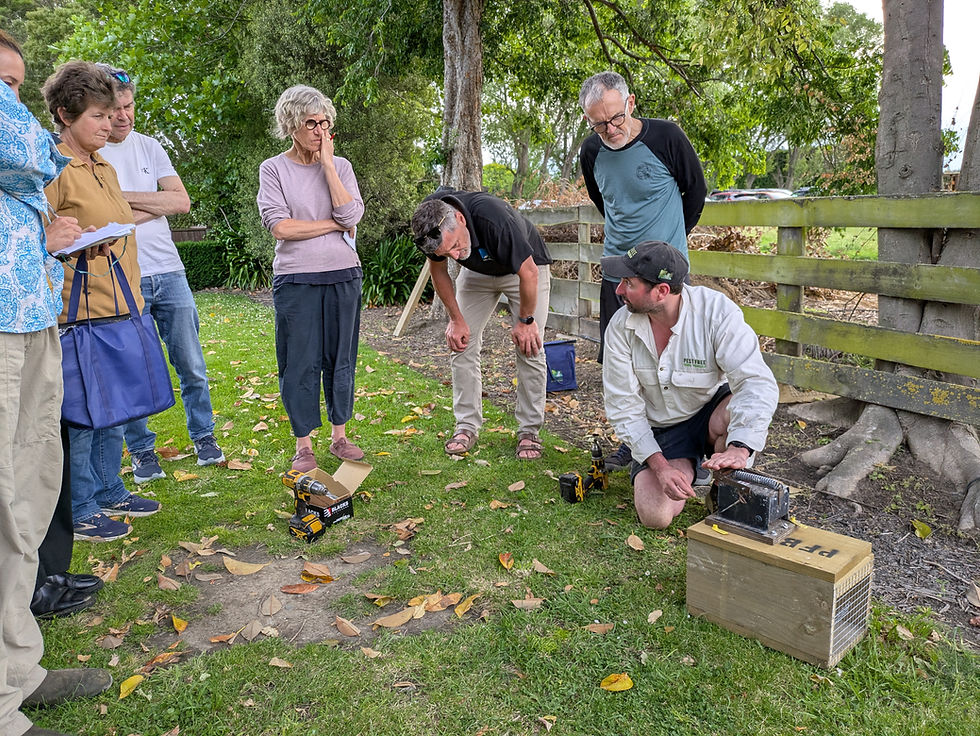
Alongside our 27-strong ‘partner army’, PFBP has amassed another pest free force to be reckoned with – our network of community trappers.
Covering many hundreds of hectares throughout the peninsula’s harbourside bays, valleys and settlements, eight community trapping groups spend their free time trapping pests. Their impact is significant – they have collectively removed thousands of pests, including weasels, possums, feral cats, rats and hedgehogs.
Becoming pest free is a shared responsibility to achieve a shared outcome - and community trapping networks are a crucial part of our strategy and success.
We also support community trapping networks beyond the peninsula into Christchurch City and wider Canterbury.

Our new mustelid and feral cat suppression workstream (MUSCAT) builds and expands on the long standing BPCT/landowner mustelid control network that has been running for over a decade in the original Wildside area.
With the removal of possums from an 8,000-ha area, we are now embarking on an ambitious - but achievable - plan to reduce mustelid and feral cat presence. These species have significant negative impacts on native biodiversity, so removing them will help nature thrive, and also enable possible translocations of treasured species lost from the peninsula.
Multi-Species Elimination on Kaitorete
Plants and animals found nowhere else in the world call Kaitorete home. They are threatened by mustelids (stoats, ferrets and weasels), feral cats, possums rabbits and hares, and hedgehogs. We are currently trialling multi-species elimination over 5,500ha with aspirations to extend this programme Peninsula-wide. This work is needed to prepare the peninsula (including the Port Hills) for species reintroductions.

Widespread on Kaitorete, hedgehogs are a key part of our elimination efforts because of their known predation on local populations of mokomoko (skinks) and pohowera (banded dotterel).
To date, we have removed 1,062 hedgehogs, and we believe they are now ‘functionally eliminated’ - this will be fully determined if and when any hedgehogs emerge following their winter hibernation period.
Our elimination efforts are hampered by hedgehogs displaying different behaviours throughout the year. Pre-hibernation is a critical time for removal as they embark on a ‘feeding frenzy, and despite our extensive camera detection networks, we have been surprised by hedgehog detections in areas presumed to have low abundance or where dog teams recorded no animals.
Our goal now, if we find any detections post-hibernation, is to identify the best tools for removing remaining or reinvading hogs. One of our best tools is the simple active fence at the Taumutu end of Kaitorete. Cameras installed along its length show that when hogs encounter a barrier-like a fence, they track down it without climbing over or digging under it, making reinvasion prevention more likely to be successful than with a trapping network.
as at October 2026

Feral cats are our most carnivorous land mammals, and their impact on native biodiversity is well documented. On Kaitorete, they are a threat to invertebrate and nesting bird populations. They also pose a threat to domesticat cats and humans through the transmission of diseases such as toxoplasmosis.
To date, more than 200 feral cats have been removed from Kaitorete, yet despite this number, they remain present during monitoring.
Our camera network indicates that cats are widespread and seemingly in high numbers on Kaitorete. Individual cats have been recorded on cameras at multiple camera sites over a few days. Birdlings Flat and Taumutu stray cats are likely significant sources of population replenishment, but the extent of this issue compared to breeding on Kaitorete is unknown. PFBP has a no understanding of population dynamics and movement patterns for control strategy and feasibility of elimination, and this is further compounded by the fact that camera monitoring during targeted cat pulses (daily feeding) has not detected or predicted any patterns in feral cat behaviour.
A planned ground-based PredaSTOP (PAPP) trial in February 2027 may prove to be a valuable tool in our goal of eliminating feral cats.
as at October 2026
.jpeg)
Mustelids (weasels, stoats and ferrets) are prolific predators of native wildlife, and their presence disrupts the delicate balance of Kaitorete’s ecosystems.
Kaitorete has been ferret-free since early 2023. The very small number of stoats detected and caught (six stoats removed to date), suggests low numbers now exist on Kaitorete.
Weasels, however, remain a problem. They are prolific predators of native wildlife; they are particularly harmful to native birds, especially ground-nesting species, as they prey on eggs, young-and adult birds. They also consume lizards and other small animals.
Weasels, remain a challenge. To date, 278 weasels have been removed from Kaitorete. A focus over the last year has been to commission studies (e.g., DNA analysis) to understand movement patterns of these cryptic pests so that we can formulate a more robust elimination approach.
A PAPP trial is underway to establish efficacy for multi-species elimination. The first round of control was recently completed and post-operational monitoring is underway.
as at October 2026

Possums have been eliminated on Kaitorete.
Possums impact specific plants or native species, and as in other areas where they are abundant, they impact pasture and exotic fruit and ornamental plants.
as at October 2026
Our New Approach
In 2026 and beyond, our programme focus on Kaitorete is to eliminate remaining hedgehogs after hibernation and eliminate feral cats, stoats and weasels.
The noticeable increase in lagomorphs (rabbits and hares) on Kaitorete has prompted collective action from the groups involved in the care and conservation of this important landscape. With representatives from DOC, CCC, Tāwhaki and Taumutu, the working group is exploring options for lagomorph control beginning late 2026.
Preventing Reinvasion
The risk of reinvasion is ever present - it is likely to occur, but we can't predict when and where. To reduce the risk of reinvasion, we have developed and installed a low height active fence on the Taumutu and Birdlings Flat boundaries.
The fence, a modified stock fence, is designed to direct an animal along the fence towards a trap. The fence has a skirt to prevent animals digging under the fence. Monitoring cameras installed along the fence help us monitor attempts of invasion. The fence is showing to be effective as, despite many attempts, no animals have got through.
%20(1)_heic.png)
The opportunity to expand the collective knowledge of feral cat control, while providing maximum protection for biodiversity, aligns with the values of PFBP and our partners.
PFBP Project Lead, Brett Butland
Feral ungulates are a global threat to biodiversity. In New Zealand their combined ecological and economic impact is estimated at more than $200 million annually. We have successfully eliminated feral goats from 4,500 hectares, and we are leading one of New Zealand’s largest feral pig elimination programmes.
We support landowners with expertise and resources to control non-native plants that smother, outcompete and prevent natural regeneration of ecosystems. This work is increasingly important in a changing climate.